A Pomona HVAC Maintenance Calendar for Trane Systems
No-fluff answer: The Pomona maintenance calendar is built around Zone 9 heat: tune the Trane cooling side in spring (March to May) before the first 90 F day, swap filters every 1 to 3 months through summer, and check the furnace in fall, so call Pomona Trane HVAC at (213) 449-4344 or book online across ZIPs 91766, 91767, and 91768.
Key details
- Best AC tune-up window: March to early May, before Pomona's heat ramps over 90 F.
- Filter changes: every 1-3 months in summer; more with pets or constant runtime.
- Spring pro checklist: capacitor load test, coil clean, charge verify, condensate drain clear.
- Fall check: flame sensor and ignition train before the first cold night.
- DIY-safe: filters, clearing debris, watching for ice/water; leave refrigerant and electrical to a tech.
- Pomona sees ~60-80 days a year at or above 90 F.
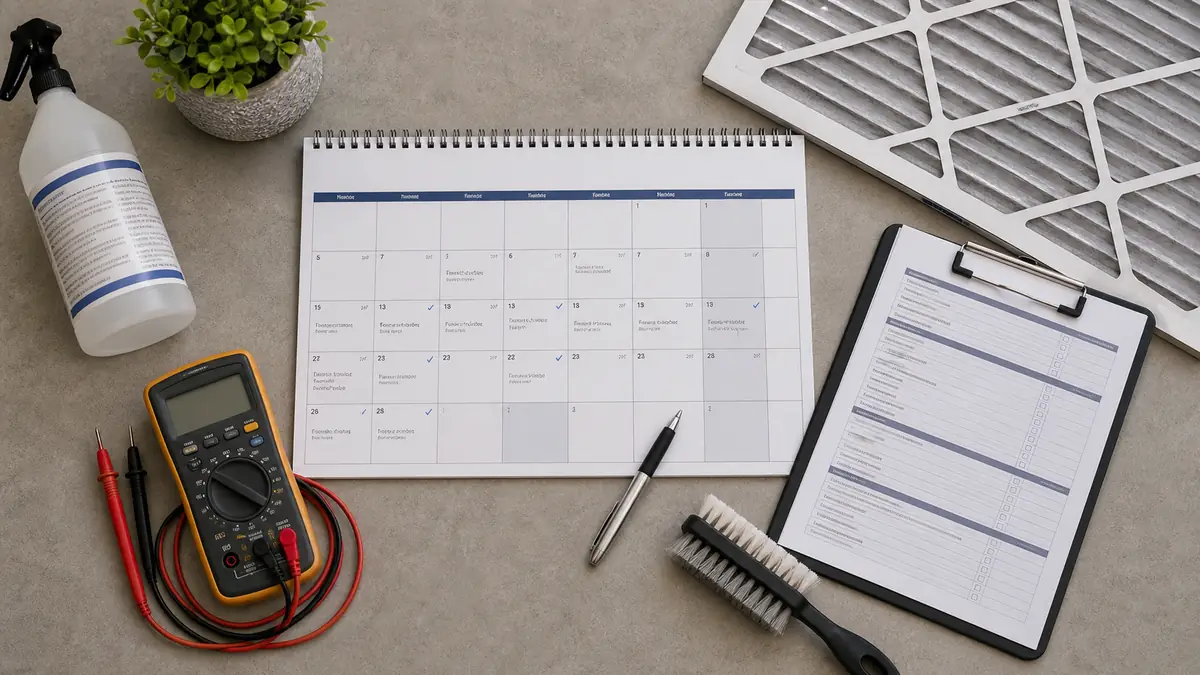
Why does Pomona need a heat-first calendar?
Most maintenance guides assume a balanced heating-and-cooling year. Pomona is not balanced - it is a cooling town. With roughly 60 to 80 days a year at or above 90 F and regular 100 F-plus Santa Ana stretches, the cooling side carries the load and fails under it. So the calendar front-loads the AC: get the capacitor, coil, and charge checked in spring before the heat arrives, ride the summer with clean filters, and give the lightly used furnace a quick fall once-over. The whole point is to move failures out of July, when a no-cooling day is a genuine health risk and every shop is slammed.
What is the month-by-month schedule?
Here is the cadence we recommend for a Pomona Trane system. The spring visit is the one that matters most; the rest is light upkeep.
| Season / month | Task | Who |
|---|---|---|
| March - May | Full AC tune-up: capacitor load test, contactor, Spine Fin coil clean, charge and superheat, condensate drain | Pro |
| June - September | Filter change every 1-3 months; keep condenser clear of debris; watch for ice or water | DIY |
| July - August (heat wave) | If cooling drops, switch off and call - do not cycle a humming unit | DIY / Pro |
| October - November | Furnace check: flame sensor, igniter, pressure switch, filter swap before first cold night | Pro |
| December - February | Watch for furnace short-cycling or no-heat; replace filter | DIY |
What is the true month-by-month Zone 9 calendar?
The seasonal table above is the shorthand; here is the month-by-month version tuned to Pomona's cooling-dominant Climate Zone 9, where the heat arrives early and lingers. Pin the spring pro visit, then ride the rest on light homeowner upkeep.
| Month | Task | Who |
|---|---|---|
| January | Mid-winter filter swap; listen for furnace short-cycling on cold nights | DIY |
| February | Clear leaves and debris off the outdoor condenser before pollen season | DIY |
| March | Book the spring AC tune-up before the schedule fills; capacitor load test, coil clean | Pro |
| April | Verify refrigerant charge and superheat; first 90 F days commonly arrive now | Pro |
| May | Confirm condensate drain is clear and pan tablet placed before heavy runtime | Pro / DIY |
| June | Fresh filter for summer; check thermostat program and setbacks | DIY |
| July | Peak load: if cooling drops, switch off a humming unit and call - do not cycle it | DIY / Pro |
| August | Mid-summer filter change; hose down the condenser fins on a cool morning | DIY |
| September | Late-heat watch; check for ice on the line set or water at the air handler | DIY |
| October | Furnace prep: flame sensor, igniter, pressure switch before the first cold night | Pro |
| November | Filter swap; test heat early so a no-heat surfaces before you need it | DIY |
| December | Watch for furnace lockouts; keep registers and returns clear | DIY |
The two anchor visits are March-April (cooling) and October (heating). Everything else is the kind of upkeep that keeps a Trane on the long end of its 12-to-18-year Pomona lifespan instead of the short end.
What does a spring tune-up actually prevent?
The two failures that strand Pomona homeowners mid-summer are a heat-cooked capacitor and a coil too dirty to reject heat. A spring visit catches both while they are cheap. A capacitor reading low under load is a planned $150 to $450 fix in April; the same part failing on a 102 F July afternoon is an emergency call at a premium rate. Cleaning the Spine Fin coil restores heat rejection so the compressor is not fighting high head pressure all summer. The math strongly favors the planned visit.
| Spring task | Failure it heads off | Avoided lane |
|---|---|---|
| Capacitor load test | Mid-heat no-cooling lockout | $150 - $450 |
| Spine Fin coil cleaning | High head pressure, high bills | $225 - $700 |
| Refrigerant charge verify | Slow leak, iced coil | $225 - $1,500 |
| Condensate drain clear | Overflow, water damage, shutdown | $150 - $400 |
What filter should a Pomona home run, and how often?
Filter choice is the maintenance decision homeowners get wrong most, and it matters more in a dusty, heavy-runtime climate like Pomona's. The trade-off is filtration versus airflow: a denser, higher-MERV filter catches more dust but adds static pressure that a residential Trane blower was not sized to fight, which can starve the coil, freeze it, or trip the furnace high-limit (a 4-flash code). For most Pomona homes a MERV 8 to 11 pleated filter is the sweet spot - real dust capture without choking airflow. Reserve MERV 13-plus for genuine allergy or wildfire-smoke needs, and only on a system the installer confirmed can handle it. Whatever you run, change it on the calendar: every 1 to 3 months in summer, monthly during a heat wave or with pets, because a unit running 12-plus hours a day in July loads a filter far faster than one cycling lightly. A 1-inch filter clogs sooner than a 4-inch media cabinet, so if you are forever forgetting, a thicker media filter buys you a longer interval. The cheapest fiberglass panels protect the blower but barely filter; the densest washable filters often restrict more than their rating admits. When in doubt, match what the airflow can carry rather than chasing the highest MERV number on the shelf.
What can I safely do myself in Pomona?
Plenty. Change the filter on schedule - it is the highest-impact homeowner task. Keep the outdoor condenser clear of leaves, clippings, and the dust that drifts in from dry months; a unit choked with debris cannot reject heat. Watch for ice on the line set or water near the air handler and call early if you see either. What to leave alone: anything involving refrigerant (it requires EPA certification and gauges), the capacitor (it holds a dangerous charge even when powered off), and the gas train. Those are tech jobs.
A worked example: what skipping the spring visit costs
Walk the numbers on a typical Pomona case. A homeowner skips the March tune-up on a 10-year XR16 to save the cost of a visit. The dual-run capacitor, already drifting low after a decade of Zone 9 heat, holds through a mild May but fails at 4 PM on a 103 F July afternoon - the worst possible time. Now it is an after-hours no-cooling call at a premium rate ($150 to $450 for the cap, toward the top of the band with the urgency), the house bakes to 90 F-plus indoors for hours, and the strained compressor took extra wear from repeated start attempts. Stack a fouled coil onto that and the compressor fought high head pressure all summer, shaving months or years off its life and quietly inflating every cooling bill. The avoided alternative was a planned April capacitor swap caught on a load test, at the calm end of the price band, with no emergency surcharge and no compressor abuse. The spring visit is cheap insurance against a July emergency - that is the whole logic of a heat-first calendar.
What is the homeowner maintenance checklist?
Keep this short list on the fridge. None of it requires tools beyond a fresh filter and a garden hose.
- Change the air filter every 1 to 3 months in summer - the single highest-impact task.
- Keep a 2-foot clearance around the outdoor condenser; pull weeds, leaves, and clippings.
- Hose the condenser fins gently from the inside out on a cool morning, power off.
- Watch for ice on the line set or water near the air handler and call early if you see either.
- If the unit hums but will not start on a hot day, switch it off - do not keep cycling it.
- Book the spring AC tune-up in March and the fall furnace check in October.
Leave the rest to a tech: refrigerant (EPA-certified, requires gauges), the capacitor (holds a dangerous charge), coil deep-cleaning, and the gas train.
How does maintenance tie into the bigger decisions?
Documented annual maintenance supports your Trane warranty and extends equipment life, which feeds directly into the repair-or-replace math: a well-maintained unit reaches the longer end of its 12-to-18-year Pomona lifespan. Bundle the pro work into a maintenance plan, and if your system is already aging, weigh the numbers on repair or replace and the Trane buying guide.
Common questions
When is the best month for a Pomona AC tune-up?
March through early May, before the first real heat. Pomona regularly hits 90 F by April or May, so a spring visit catches a weak capacitor or a fouled coil while the weather is mild and the schedule is open - not during the July rush when everyone's unit fails at once.
How often should I change my filter in Pomona?
Every 1 to 3 months during heavy summer runtime, more often if you have pets or the unit runs constantly through a heat wave. A clogged filter starves airflow, freezes the coil, and can trip the furnace high-limit. It is the single cheapest, highest-impact thing a homeowner can do.
Do I need professional maintenance, or can I do it myself?
Both. You can change filters, keep the outdoor unit clear of leaves and clippings, and watch for ice or water. Leave the refrigerant charge, capacitor load test, coil cleaning, and electrical inspection to a tech - those need gauges, a meter, and EPA-certified handling.
Is fall worth a visit if Pomona winters are mild?
A short one, yes. A furnace that sat idle all summer often fails on the first cold night, usually a varnished flame sensor. A quick fall check of the ignition train and a filter swap heads off a no-heat call on the first 40 F evening.
Does annual maintenance keep my Trane warranty valid?
It supports it. Trane's warranty terms expect the equipment to be installed and maintained properly, and documented annual service is the paper trail that backs a claim if a part fails early. Beyond the warranty angle, a unit that gets its coil cleaned and capacitor checked every spring simply reaches the longer end of its 12-to-18-year Pomona lifespan.
How much does a maintenance visit save versus an emergency call?
The math favors the plan. A capacitor caught on a spring load test is a calm $150 to $450 job; the same part failing at 4 PM on a 103 F July afternoon is an after-hours call near the top of that band, plus a baking house and extra compressor wear. Prevention also protects the expensive parts - a coil kept clean spares the compressor from fighting high head pressure all summer.
Last updated 2026-06-13.