Trane AC Not Cooling in Pomona
No-fluff answer: A Trane AC that runs but will not cool in Pomona usually has a failed dual-run capacitor, low refrigerant from a leak, or a dirty Spine Fin coil, so call Pomona Trane HVAC at (213) 449-4344 or book online for service across ZIPs 91766, 91767, and 91768, from Westmont to the historic core. Capacitor repairs run a typical $150 to $450.
Key details
- Top cause in SoCal heat: failed dual-run capacitor (hums, will not start on hot days).
- Other causes: pitted contactor, low refrigerant (leak), dirty Spine Fin coil, dead condenser fan.
- Quick homeowner checks: clogged filter and a non-spinning outdoor fan.
- Non-communicating XR/XL units give no numeric code - diagnosis is electrical metering.
- Repair lanes: capacitor $150-$450, contactor $150-$450, leak/recharge $225-$1,500.
- Service area: Pomona + Lincoln Park, Wilton Heights, Hacienda (91766-91768).
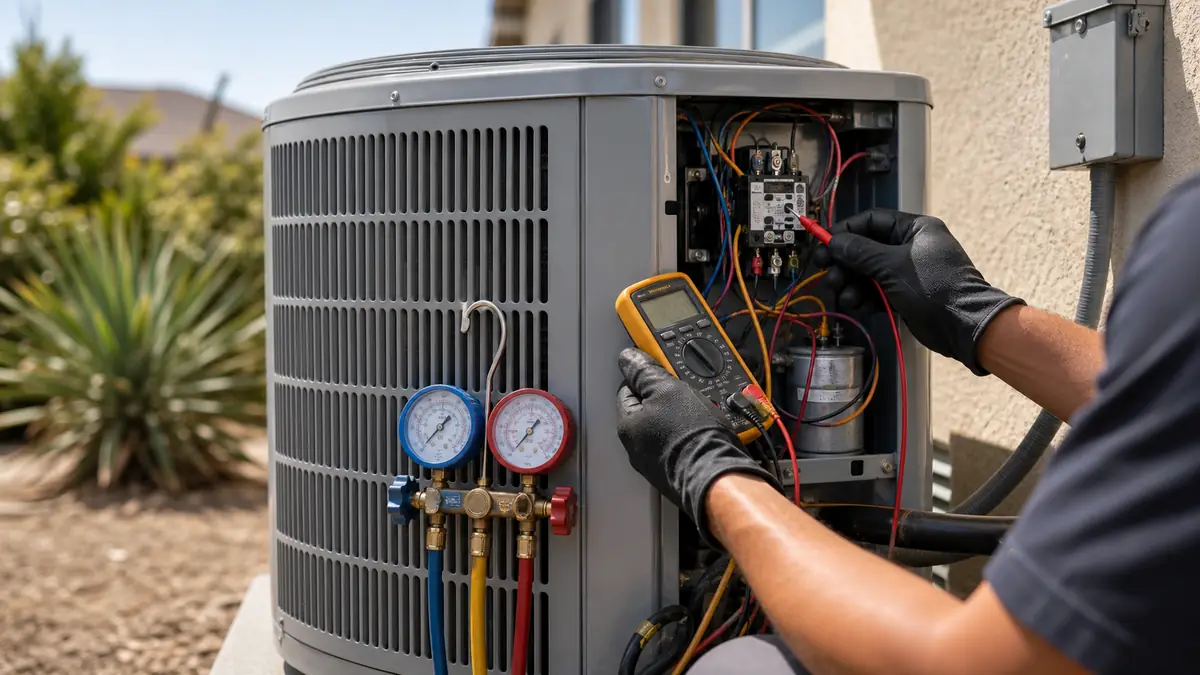
Why is my Trane blowing warm air in Pomona?
If the system runs but air is warm, the cooling cycle is broken somewhere. In Pomona's sustained Zone 9 heat the usual suspect is the dual-run capacitor - the part that delivers start torque to the compressor and fan. As it degrades, the unit hums and quits on hot afternoons. Behind that come a pitted contactor, a refrigerant leak, a dirty Spine Fin coil that cannot shed heat, or a dead outdoor fan motor. The table ranks them.
| Symptom | Likely cause / first check | Cost lane |
|---|---|---|
| Hums, compressor or fan will not start | Failed dual-run capacitor; meter capacitance | $150 - $450 |
| Clicks, intermittent start | Pitted/welded contactor; inspect contacts | $150 - $450 |
| Weak cooling, ice on coil/line | Low refrigerant from a leak; leak search + recharge | $225 - $1,500 |
| Long runtime, high head pressure | Dirty Spine Fin coil; clean and verify charge | $225 - $700 |
| Outdoor fan dead, compressor hot | Condenser fan motor failure; replace motor | $300 - $900 |
How does a tech diagnose no-cooling step by step?
The order is electrical, then refrigerant, then airflow - cheapest and most common first. The tech meters the dual-run capacitor against its rating (a 45/5 microfarad cap reading 38/3 is failed even though it is not visibly bulged), then checks the contactor for pitted contacts and the correct 24-volt pull-in. With the unit running, gauges go on the service ports: a Trane R-410A system holding roughly 118 to 125 psi suction at a normal coil temperature is in range, while a suction pressure dragging low with high superheat points straight to a leak and undercharge. A clamp meter on the compressor confirms it is drawing locked-rotor amps (a stuck start) versus running amps. Last, a temperature split across the indoor coil - supply versus return air - should sit near 16 to 22 F; a narrow split with good charge usually means a dirty Spine Fin coil or a blower problem rather than a refrigerant fault.
What can I safely check before calling?
Two things. First, pull the air filter - if it is gray and packed, replace it, since a choked filter starves the coil and can freeze it. Second, look at the outdoor unit: is the top fan spinning when the system calls for cool? If it hums but the fan or compressor is still, switch the system off (do not keep cycling it) and call. Anything past that - metering a capacitor, putting gauges on the refrigerant ports, or testing the contactor - is a pro job, because a capacitor holds a dangerous charge and refrigerant work needs EPA certification. Forcing repeated starts on a bad capacitor can overheat the compressor windings.
Why are capacitors the usual culprit in Pomona?
Pomona logs roughly 60 to 80 days a year at or above 90 F with regular 100 F-plus stretches. That sustained heat cooks the capacitor's electrolyte, capacitance drifts low, and the start torque eventually is not there. It is the single most common AC failure in Southern California and a cheap, fast repair - which is why our trucks carry them. We meter the actual capacitance rather than guessing from age. During a heat wave this is an emergency AC repair we prioritize.
When is it bigger than a quick repair?
If metering points to a seized compressor or the leak is in the Spine Fin coil on an aging condenser, you are into compressor ($1,200-$3,500) or replacement territory. On a unit past 12 to 15 years, that is when we walk the repair-versus-replace math honestly. See the full breakdown on repair or replace your AC, or the XR AC line page for replacement options.
Common questions
My Trane runs but blows warm air - what is the first thing to check?
Two quick checks before you call: confirm the air filter is not choked and the outdoor condenser fan is actually spinning. A clogged filter starves airflow and a dead outdoor fan stops heat rejection - both make a running system blow warm. If those are fine, it is most likely a capacitor or refrigerant issue we need to meter.
Why does my AC quit only on the hottest Pomona afternoons?
Classic weak-capacitor behavior. A capacitor that is degrading still starts the compressor on a mild morning but cannot supply enough start torque once the head pressure climbs on a 100 F Pomona afternoon - so it hums and quits when you need it most. It is the top SoCal AC failure and a fast fix.
How do I know if it is low on refrigerant?
Signs are weak cooling, longer run times, ice forming on the indoor coil or the line set, and sometimes a hissing leak. Refrigerant does not get 'used up' - if it is low, there is a leak. We find and repair the leak, then recharge; just topping it off without fixing the leak is throwing money away.
Could it be the thermostat and not the AC?
Sometimes. A dead C-wire, wrong setting, or on a communicating system a ComfortLink II fault can stop a cooling call. We rule the control out early - it is a cheap check - before opening up the condenser, so you are not paying for compressor diagnosis when the thermostat lost power.
Last updated 2026-06-13.