Trane Furnace 6 Flashes in Pomona
No-fluff answer: A Trane furnace showing 6 flashes in Pomona, CA means reversed 115VAC line polarity or poor grounding, a wiring fault the control flags before it will run the burners safely. Call Pomona Trane HVAC at (213) 449-4344 or book online and we correct the polarity and ground at ZIP 91766.
Key details
- 6 flashes = reversed line (115VAC) polarity or a poor/missing ground at the furnace.
- The control checks polarity and ground because flame sensing depends on a solid earth reference.
- Common triggers: a miswired receptacle, a swapped hot/neutral, a loose ground, or recent electrical work.
- Affected points: line wiring, ground conductor, furnace junction/outlet, and a rollout-safety check.
- Cost lane: a wiring and ground correction typically within a $79 to $200 visit.
- Service area: Pomona + Lincoln Park, Wilton Heights, Hacienda, Phillips Ranch, Westmont (91766-91768).
What does 6 flashes mean on a Trane furnace?
Six flashes is the line-polarity and grounding fault code. Before a Trane integrated furnace control will fire the burners, it checks two things about the 120-volt power feeding it: that the hot and neutral conductors are on the correct terminals, and that the chassis has a solid ground. If hot and neutral are swapped - reversed polarity - or if the ground is missing or high-resistance, the board refuses to run and blinks six times. This is not the furnace being fussy. The control reads the burner flame by rectification, a process that runs a tiny current from the flame sensor through the flame to ground, and that only works if the ground is good and polarity is correct. So the 6-flash check is really protecting the flame-safety system: if the board cannot trust its ground reference, it cannot trust that it can prove or lose flame, and it will not light gas it cannot watch.
Why would a Pomona furnace see reversed polarity?
Wiring history. Pomona's housing core is full of pre-war Craftsman, Mission, and Tudor homes around Lincoln Park and Wilton Heights that were originally wired in an era of two-prong, ungrounded circuits. Over decades those circuits got extended, re-fed, and adapted, and somewhere along the way a hot and neutral can end up swapped or a ground left disconnected at a junction or receptacle. A furnace that ran fine for years can throw 6 flashes the first cold morning after unrelated electrical work nearby - an outlet replaced, a subpanel added, a transfer switch or backup generator installed - because that work crossed the conductors or lifted the ground. We also see it after a furnace was moved or swapped and rewired to the existing whip. In the newer two-story tract on the Phillips Ranch and Westmont side the circuits are grounded and consistent, so a 6-flash there points more often at a single bad device or a loose ground lug than at era-of-the-house wiring.
How do you diagnose a 6-flash code?
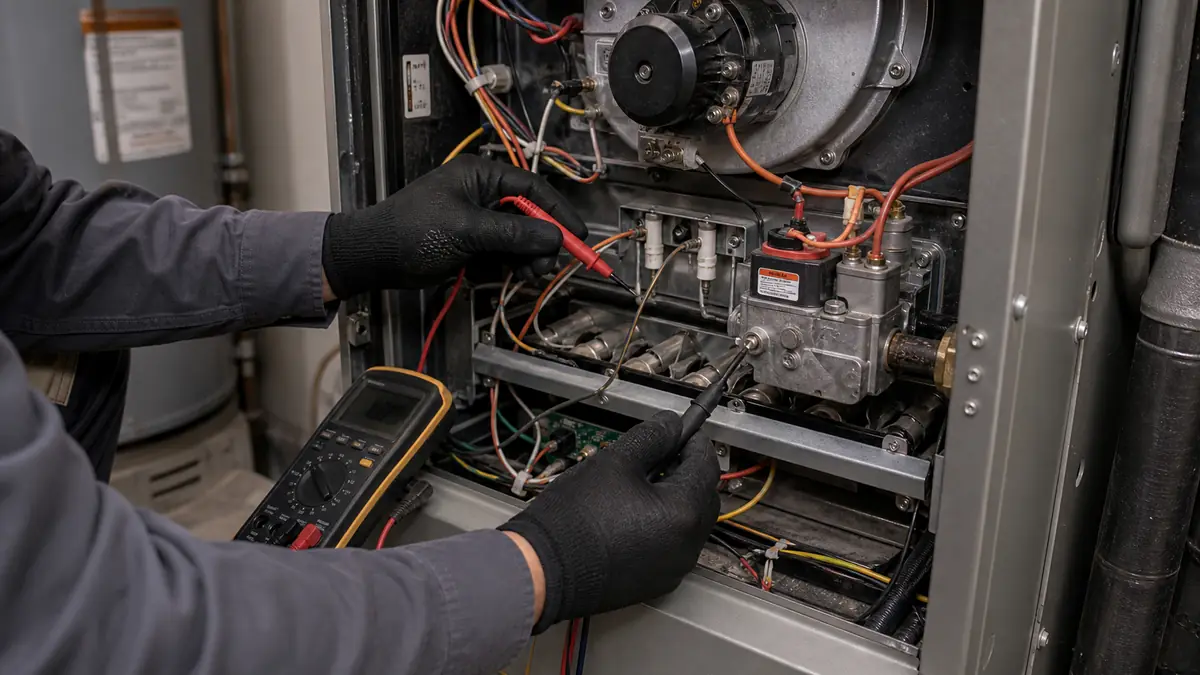
This one is electrical, and we work it with a meter, not by swapping parts. First we confirm the 6-flash count and rule out a simple cause - the furnace must be on a correctly wired 120-volt circuit. We put the meter across the furnace's line connection: hot to neutral should read line voltage near 120 volts, hot to ground should read roughly the same, and neutral to ground should read close to zero. If hot-to-ground reads low while neutral-to-ground reads near line voltage, polarity is reversed - hot and neutral are swapped. We measure ground resistance and look for a missing or corroded ground conductor at the furnace junction and back at the receptacle or panel. We tighten and inspect every connection on the run, because a loose neutral or ground can mimic the fault intermittently. We also verify the rollout and limit safeties are intact, since the 6-flash check sits in the same safety chain. Once polarity is corrected and the ground is solid, the meter readings line up and the code clears.
What should I not try myself here?
This is the code where homeowner DIY can be genuinely hazardous, so the safe-versus-pro line is sharp. Safe to do: confirm the furnace switch and breaker are on, note whether any electrical work happened recently near the furnace, and reset the board once by cutting power for thirty seconds. That is the end of the safe list. Do not open the furnace junction box, rewire a receptacle, or chase the ground yourself - reversed polarity means a live conductor may be where you do not expect it, and working a powered 120-volt circuit without the right meter and lockout is how people get hurt. Correcting polarity and verifying a ground is licensed, instrumented work. If the fault lives in the panel or an old branch circuit, the right answer may be a licensed electrician for the panel side and our team for the furnace side - we coordinate that rather than guess.
What passes and what fails the polarity check?
It helps to know what the board is actually measuring, because it explains why some fixes work and others do not. A correctly wired furnace circuit gives three clean meter readings: hot to neutral near 120 volts, hot to ground near 120 volts, and neutral to ground near zero. The control trusts that pattern and runs. Reversed polarity flips it - hot to ground drops low while neutral to ground jumps up toward line voltage - and the board blinks six. A missing or high-resistance ground fails the check a different way: even with hot and neutral correct, the flame-rectification reference is gone, so the control cannot prove flame and treats the circuit as unsafe. That is why simply jumping or bypassing the safety never works and is dangerous - the fault is in the conductors, not the board. It is also why a loose ground lug at the furnace, a backed-out neutral at a worn receptacle, or a paint-fouled ground screw can all produce the same 6-flash even though the breaker is on and the furnace has power. We chase the actual conductor that broke the pattern and restore the clean three-reading set before we call it fixed.
Is a 6-flash code an emergency?
It is more serious than a routine no-heat lockout, even though the furnace has safely refused to run. A grounding or polarity fault means a safety circuit is compromised, and poor grounding can leave a metal chassis at an unsafe potential, so leaving the furnace powered and trying to force it is the wrong move. It is not a leave-the-house emergency the way a gas smell is - if you smell rotten eggs, that is separate and immediate: get out and call the gas utility from outside. For a 6-flash with no gas odor, the right step is to leave the furnace off and book a prompt visit so the wiring is corrected before the furnace runs again. We handle these across the 91766 to 91768 ZIPs; if it is a cold night with no heat, see emergency HVAC service, and the full code reference is on the Trane error codes hub alongside the Trane furnace repair page.
Common questions
What is reversed polarity on a furnace, in plain terms?
It means the hot and neutral wires feeding the 120-volt furnace circuit are swapped. The furnace still gets 120 volts, but the integrated control senses voltage on the neutral side relative to ground and refuses to run, blinking six flashes. The fix is correcting the two wires at the receptacle, the furnace junction, or the breaker so hot and neutral land where they belong.
Why did 6 flashes start after I had work done near the furnace?
That timing is a strong clue. A 6-flash code right after an outlet swap, a panel change, a generator or transfer-switch install, or a furnace move usually means hot and neutral got crossed during that work, or the ground was left off. The control was fine before; the wiring around it changed. We trace the circuit back from the furnace to find where the polarity or ground broke.
Can a grounding problem really stop the furnace from running?
Yes. A Trane control uses the ground and the flame-sense circuit together - flame rectification needs a solid earth reference to read the burner flame. Poor grounding can disable that sensing and trip the board's polarity-and-ground check, which is the 6-flash code. It is a real safety interlock, not a nuisance, so the furnace stays locked out until the ground is sound.
How much does fixing a 6-flash Trane code cost in Pomona?
Usually it is a wiring and ground correction handled within a standard $79 to $200 diagnostic visit, because the parts are minimal - it is the testing and the repair of a crossed or missing conductor. If the fault traces to a deteriorated circuit, a bad receptacle, or panel-side work, costs rise with the scope, and on older homes a licensed electrician may be the right call for panel repairs.
Last updated 2026-06-13.