Trane HVAC Maintenance Plans in Pomona
No-fluff answer: Pomona Trane HVAC runs Trane maintenance plans across Pomona and ZIPs 91766, 91767, and 91768, built around the city's Climate Zone 9 heat, so call us at (213) 449-4344 or book online. A spring visit cleans the Spine Fin coil, load-tests the capacitor, and verifies charge before the first 100 F stretch, on a $119 to $400 yearly plan.
Key details
- Visit checklist: capacitor load test, contactor inspection, Spine Fin coil clean, charge and superheat verify.
- Also covered: static pressure, ECM blower, condensate drain, ComfortLink II alert review, filter swap.
- Plan lane: typical 2026 SoCal $119 to $400 per year depending on system count and tier.
- Best timing: March-May, before Pomona's heat ramps to 60-80 days a year over 90 F.
- Service area: Pomona + Lincoln Park, Wilton Heights, Hacienda, Phillips Ranch (91766-91768).
- Dated service records support manufacturer warranty claims.
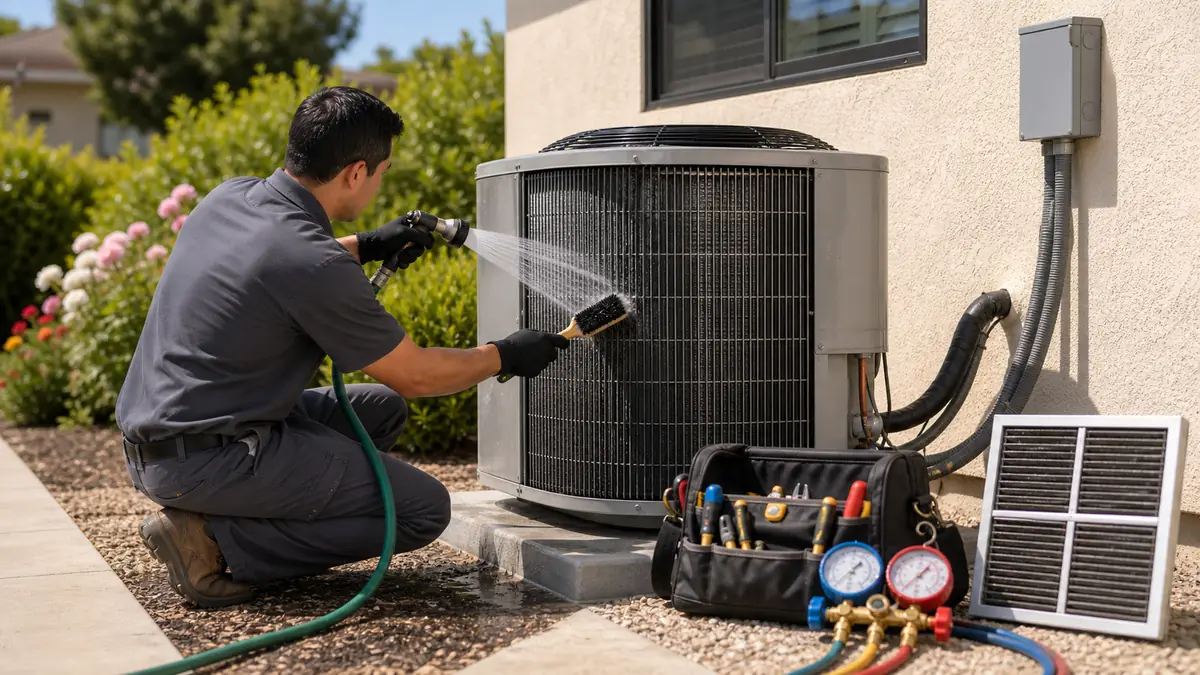
Why does Pomona heat make maintenance pay off?
The two failures that strand a Pomona homeowner mid-summer - a cooked dual-run capacitor and a coil so packed with Fairplex-area dust it cannot reject heat - are exactly what a spring visit catches. A capacitor that reads low under load is a $150 to $450 planned fix in April; the same part failing on a 102 F July afternoon is an emergency call. Maintenance trades a known small cost for an avoided large one.
| Maintenance check | Failure it heads off / first sign | Avoided repair lane |
|---|---|---|
| Capacitor load test | Weak capacitor - hard starts, no-cooling lockout | $150 - $450 |
| Spine Fin coil cleaning | Heat-rejection loss - high pressure, high bills | $225 - $700 |
| Refrigerant charge / superheat | Slow leak - iced coil, weak cooling | $225 - $1,500 |
| Condensate drain clear | Overflow - water damage, float-switch shutdown | $150 - $400 |
| Contactor inspection | Pitted/welded contacts - chatter, failure to start | $150 - $450 |
| ComfortLink II alert review | Drifting thermistor or comm fault on XV systems | $150 - $2,000 |
| ECM blower / static pressure | Airflow loss - high-limit trips, motor strain | $450 - $2,300 |
What is the full Trane tune-up sequence?
We work the system in the same bench order every visit so nothing gets missed. Electrical comes first: the dual-run capacitor tested under load against its rated microfarads, the contactor inspected for pitting and burn, incoming voltage and condenser-fan amp draw read with a clamp meter. The refrigerant side is next - gauges on the R-410A circuit to confirm superheat and subcooling against the charge target, which catches a slow leak before it ices the coil. Then airflow: total external static pressure across the ECM blower, a fresh filter, and a Spine Fin condenser coil cleaned of the Fairplex-area dust that throttles heat rejection. We clear the condensate drain and float switch, and on a communicating system we pull the ComfortLink II XL824/XL850 alert history to catch a drifting thermistor early. You leave with a dated report.
Does the tune-up change by Trane system type?
Yes - the checklist scales with the equipment:
- Single-stage XR (XR13-XR17): the capacitor-and-coil basics carry the day; these are simple, durable units where a clean coil and a healthy capacitor prevent most summer failures.
- Two-stage XL and variable-speed XV18/XV20i: add inverter-board and thermistor checks plus a staging verification, since a drifting sensor or a comm glitch degrades comfort before it fully fails.
- Heat pumps (4TWR/4TWV): we add a reversing-valve and defrost-control check and verify heating-mode charge, because these run year-round, not just in summer.
- Furnaces (80% to XC95m): a fall visit cleans the flame sensor, checks the igniter and inducer, and on condensing units clears the secondary condensate drain.
What is on a Trane maintenance visit?
We work the system like a bench job: electrical first (capacitor under load, contactor for pitting, voltage and amp draw), then the refrigerant side (charge, superheat, subcooling), then airflow (static pressure, ECM blower, filter, coil). We clear the condensate drain, clean the Spine Fin condenser coil, and on communicating systems we pull the ComfortLink II XL824/XL850 alert history. You get a dated report - useful if a warranty part later fails.
How does maintenance protect my warranty?
Trane's parts warranty generally assumes documented annual service. If a covered compressor or board fails and there is no maintenance record, the manufacturer can push back. We keep the cooling side clean and leave a dated record you can hand to Trane's authorized servicer - and for any in-warranty failure we point you there first, then handle the out-of-warranty labor or future work. See how our independence policy works.
What does a Pomona maintenance plan cost?
Plans run a typical 2026 SoCal $119 to $400 per year, and the spread tracks what you are protecting. A single-system, single-stage XR home is the low end - one cooling visit, capacitor and coil focus. A home with both an AC and a furnace, or a two-stage system, sits mid-range with a spring cooling visit and a fall heating visit. A variable-speed XV20i or a heat pump that runs year-round is the upper end, because the inverter-board, thermistor, and staging checks take longer and protect a $400 to $2,000 communicating board. Against that, the single most common SoCal failure - a capacitor caught in spring - is a $150 to $450 planned fix instead of an emergency call during a 102 F July afternoon. The math favors the plan in this climate.
Why does Pomona's climate make maintenance non-optional?
Pomona logs 60 to 80 days a year at or above 90 F with regular 100 F-plus Santa Ana stretches, so the cooling system runs longer and harder than in almost any other San Gabriel Valley city. Sustained heat is what cooks capacitor electrolyte and drifts capacitance, and the dust kicked up around the Fairplex and the dry inland air packs a condenser coil faster than coastal conditions would. A coil that cannot reject heat raises head pressure, lengthens runtime, and strains the compressor - the most expensive part on the unit. Pre-summer service in March through May, before the heat ramps, is the window where a small planned fix replaces a mid-heat-wave breakdown.
Is a plan worth it for newer Pomona homes?
Newer Phillips Ranch and Ganesha Hills systems carry more sensors and a communicating inverter board - the priciest part to replace at $400 to $2,000. Charge verification and early thermistor-drift detection protect that board and keep two-stage staging accurate. Tie it together with the Pomona maintenance calendar for the month-by-month schedule.
Common questions
When should I schedule a Pomona tune-up?
Spring, before the first heat spike. Pomona regularly hits 90 F by April or May and stays there; a March or April visit catches a weak capacitor or a dirty Spine Fin coil while it is a $150 fix instead of a no-cooling emergency during a July Santa Ana stretch.
What is actually checked on a Trane maintenance visit?
We test the dual-run capacitor under load, inspect the contactor for pitting, clean the Spine Fin condenser coil, verify refrigerant charge and superheat, check static pressure and the ECM blower, clear the condensate drain, and read any ComfortLink II alerts. The capacitor test alone heads off the top SoCal failure.
Does maintenance keep my Trane warranty valid?
It helps. Trane's parts warranty generally expects documented annual maintenance; skipping it can give grounds to deny a claim. We leave a dated service record you can show the manufacturer's authorized servicer if a covered part fails.
Is a plan worth it for a newer Phillips Ranch system?
Yes - newer two-stage and variable-speed units have more sensors and a communicating board that benefit from charge verification and firmware checks. Catching a drifting thermistor early prevents a comfort complaint and protects the inverter board, the most expensive part on the unit.
How often should a Pomona Trane system be serviced?
Once a year for an AC-only or furnace-only home, scheduled in spring for cooling. A heat pump that runs year-round, or a home with both an AC and a separate furnace, is better served twice - a spring cooling visit and a fall heating visit - so both sides are checked before their peak season.
Do you clean the Spine Fin coil or just hose it?
We clean it properly. Trane's all-aluminum Spine Fin coil is delicate and bends easily, so we use a coil-safe cleaner and gentle technique rather than a high-pressure blast that flattens fins and cuts heat rejection. Fairplex-area dust packs these coils, and a careful clean restores capacity without damage.
Last updated 2026-06-13.