Trane Furnace 4 Flashes in Pomona
No-fluff answer: A Trane furnace showing 4 flashes in Pomona, CA means an open high-temperature limit: the furnace overheated and tripped its safety, almost always from restricted airflow in a 91767 home. Call Pomona Trane HVAC at (213) 449-4344 or book online and we clear the restriction the same week.
Key details
- 4 flashes = open high-temperature limit (the furnace overheated and shut off on safety).
- Root cause is almost always low airflow: a clogged filter, dirty blower wheel, dirty coil, or choked ductwork.
- Affected parts: air filter, blower wheel/ECM motor, high-limit switch, return and supply ductwork.
- First safe check: replace a dirty filter and clear blocked supply registers.
- Cost lane: airflow repair $119 to $600; a failed limit switch roughly $150 to $350.
- Service area: Pomona + Lincoln Park, Wilton Heights, Hacienda, Phillips Ranch, Westmont (91766-91768).
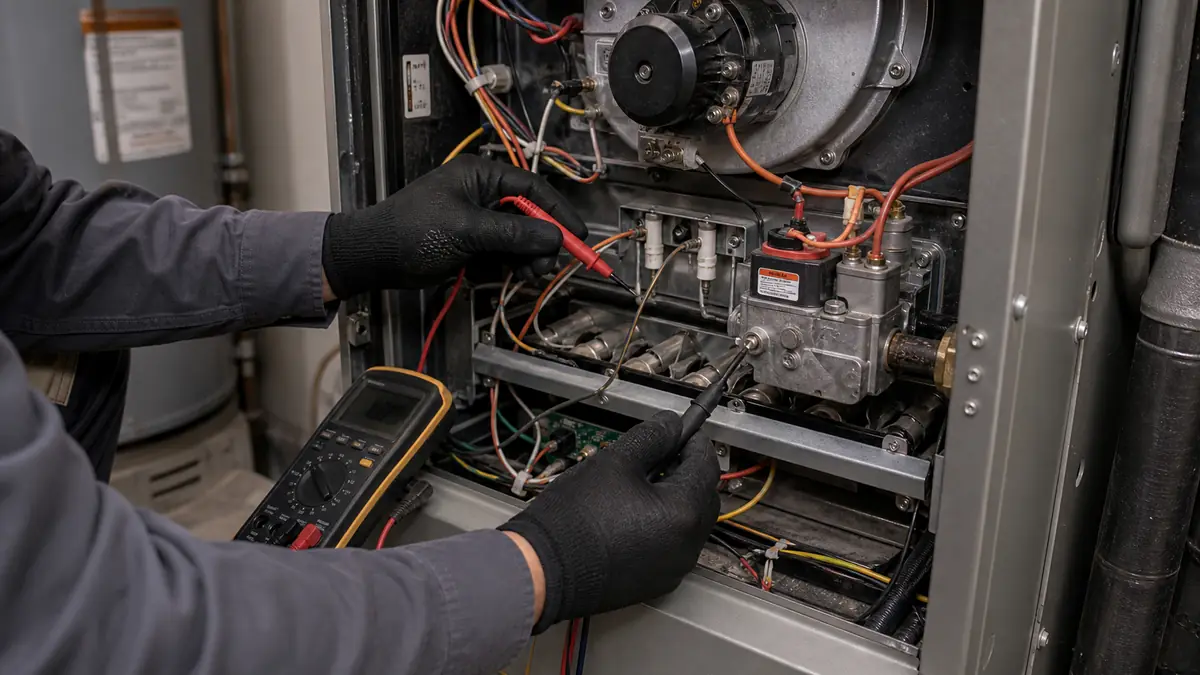
What does 4 flashes mean on a Trane furnace?
Four flashes on the integrated furnace control LED is the open high-temperature limit code. The high-limit is a thermal switch clamped to the heat-exchanger plenum; it is normally closed, and it opens when the air around the exchanger climbs past a fixed setpoint - typically in the 160 to 200 F range depending on the model. When it opens, the IFC kills the gas valve, runs the blower to dump the heat, and blinks four times to log why. So the code is not really a complaint about the limit switch - the switch is the messenger. It is telling you the heat exchanger got too hot, and on a Trane furnace that nearly always traces back to one thing: not enough air moving across the exchanger to carry the heat away. Find the airflow restriction and the 4-flash code disappears.
Why is my Trane tripping the high-limit in Pomona?
Airflow restriction has a short list of usual causes, and Pomona's housing and climate tilt the odds toward a couple of them. A packed air filter is the number-one culprit - and during a dry Santa Ana stretch in the far-eastern San Gabriel Valley, dust loads a filter in weeks, not months. After that comes a dirty blower wheel (each fin caked with dust moves less air), a dirty evaporator coil sitting above the furnace, and undersized or partly blocked ductwork. That last one is common in the older revival-era homes around the Lincoln Park Historic District and Wilton Heights, where a forced-air furnace was retrofitted into a tight hall closet decades after the house was built, with return-air grilles too small for the blower. Closed or furniture-blocked supply registers in a single room can choke a system too. A slowing ECM or PSC blower motor and a fan speed wired too low for the duct system round out the list. The furnace itself is usually fine; the air path around it is the problem.
How do you diagnose a 4-flash code?
The walkthrough is airflow-first because that is where the answer lives. We confirm the 4-flash count through the sight window, then pull the filter and look - a gray, collapsed filter is often the whole story. Next we measure: a manometer reads total external static pressure across the air handler, and a Trane furnace pushing well past about 0.8 inches of water column is fighting its ductwork, which starves airflow and overheats the exchanger. We check the temperature rise - supply minus return air - against the data-plate range stamped on the furnace (commonly 35 to 65 F); a rise running above the top of that band confirms airflow is too low for the firing rate. A clamp meter on the blower motor and a look at the blower wheel tell us whether the motor is weak or the wheel is caked. We ohm the high-limit switch cold to see if it has failed open or drifted, and we inspect the heat exchanger, because chronic overheating is exactly what cracks one. Only after the readings point somewhere do we quote a part.
What can I safely check before calling?
Two homeowner checks are safe and often solve it. First, replace the air filter with the correct size and a moderate MERV - a too-dense filter can itself starve a marginal duct system, so match what the furnace was designed for. Second, walk the house and open every supply register and make sure return grilles are not blocked by a rug, a couch, or a curtain; a single closed-off room can drop system airflow enough to trip the limit. After that, reset the furnace once by cutting power at the switch for thirty seconds. If the 4-flash code returns after a clean filter and open registers, stop there. Opening the blower compartment, measuring static pressure, cleaning a blower wheel, or testing the limit and heat exchanger are pro jobs - they need a manometer, a meter, and combustion knowledge, and a furnace that overheats repeatedly should be inspected before it runs again.
How does temperature rise tie into the 4-flash code?
Temperature rise is the single most useful number on a 4-flash call, so it is worth understanding. Every Trane furnace data plate stamps a rise range - say 35 to 65 F - and that band is the gap between return-air temperature and supply-air temperature the furnace was engineered to produce at its rated firing rate. Rise is just heat output divided by airflow: hold the firing rate steady and cut the airflow, and the rise climbs. When the blower is moving too little air - dirty filter, caked wheel, choked duct - the rise pushes past the top of the plate range, the plenum runs hotter than designed, and the high-limit eventually opens at four flashes. We measure rise with a pair of thermometers in the supply and return plenums and compare it to the plate. A reading well above the band confirms airflow is the problem and points us at the filter, the blower, or the ductwork rather than the burners or the gas valve. It also catches the opposite trap: a filter so dense it strangles a marginal duct system, which is why we match filter MERV to what the furnace was designed to pull rather than installing the thickest one on the shelf.
When is a 4-flash code urgent?
If a fresh filter and open registers clear it, you are fine - run the furnace and move on. It becomes urgent when the code keeps returning, because repeated overheating is what cracks a heat exchanger, and a cracked exchanger leaks combustion gases including carbon monoxide. On any Trane furnace we find a confirmed crack on, we red-tag and shut it down rather than patch it - that is a non-negotiable safety call. A 4-flash that recurs through a cold Pomona night is worth a same-week visit rather than a reset loop. And as always, any rotten-egg gas smell is a separate, immediate emergency: leave the home and call the gas utility from outside. If yours keeps locking out, compare the repair-versus-replace math on repair or replace, or look at current furnaces on the Trane gas furnace page. The full overview of every code lives on the Trane error codes hub.
Common questions
Can I just replace the high-limit switch to stop the 4 flashes?
No - that usually hides the real fault. The limit switch is doing its job by tripping; the furnace is genuinely overheating from restricted airflow. Swapping the switch on an overheating furnace can let the heat exchanger run too hot and crack. We fix the airflow first - filter, blower, coil, duct - and only replace the limit if it has actually failed open or drifted out of spec.
Why does my furnace work for a few minutes then show 4 flashes?
That delayed trip is the signature of a high-limit fault. The burners light and heat builds normally, but with weak airflow the heat exchanger temperature keeps climbing past the limit's setpoint, so a few minutes in the switch opens and the board logs 4 flashes. As soon as airflow is restored - a fresh filter, a cleaned blower wheel - the furnace runs the full cycle without tripping.
Is a 4-flash code dangerous in my Pomona home?
It is a safety shutdown, so the immediate risk is low - the limit did exactly what it should. The concern is the cause. Chronic overheating stresses the heat exchanger, and a cracked exchanger is a carbon-monoxide risk we red-tag, never patch. If the code keeps returning after a filter change, stop running the furnace and have it checked rather than resetting it on a loop.
How much does it cost to fix a 4-flash Trane furnace in Pomona?
Most 4-flash repairs are airflow fixes in the $119 to $600 range - a filter and blower-wheel cleaning at the low end, a failed ECM blower module or significant duct correction higher. A high-limit switch that has truly failed runs roughly $150 to $350 installed. We give the number after we find why the airflow dropped, not before.
Last updated 2026-06-13.