Repair or Replace Your AC in Pomona: A Trane Guide
No-fluff answer: Replace your Trane AC in Pomona once a single repair would cost roughly 50 percent of a new system AND the condenser is 10 to 12 years old, or once age multiplied by repair cost tops about $5,000, so call Pomona Trane HVAC at (213) 449-4344 or book online to run that math at the bench across ZIPs 91766, 91767, and 91768.
Key details
- 50% rule: a repair past half a new system's cost, plus age over 10-12 years, tips toward replace.
- Age-times-cost rule: multiply unit age by the repair quote; clear ~$5,000 and replace starts winning.
- Typical Trane AC lifespan in Pomona heat: ~12-18 years, shortened by sustained Zone 9 load.
- New central AC (condenser + coil): typical 2026 SoCal $5,000 to $12,000 installed.
- R-410A phase-down makes recharging old leaking systems costlier over time.
- Federal 25C tax credit ended 12/31/2025; confirm any live CA rebate before you bank on it.
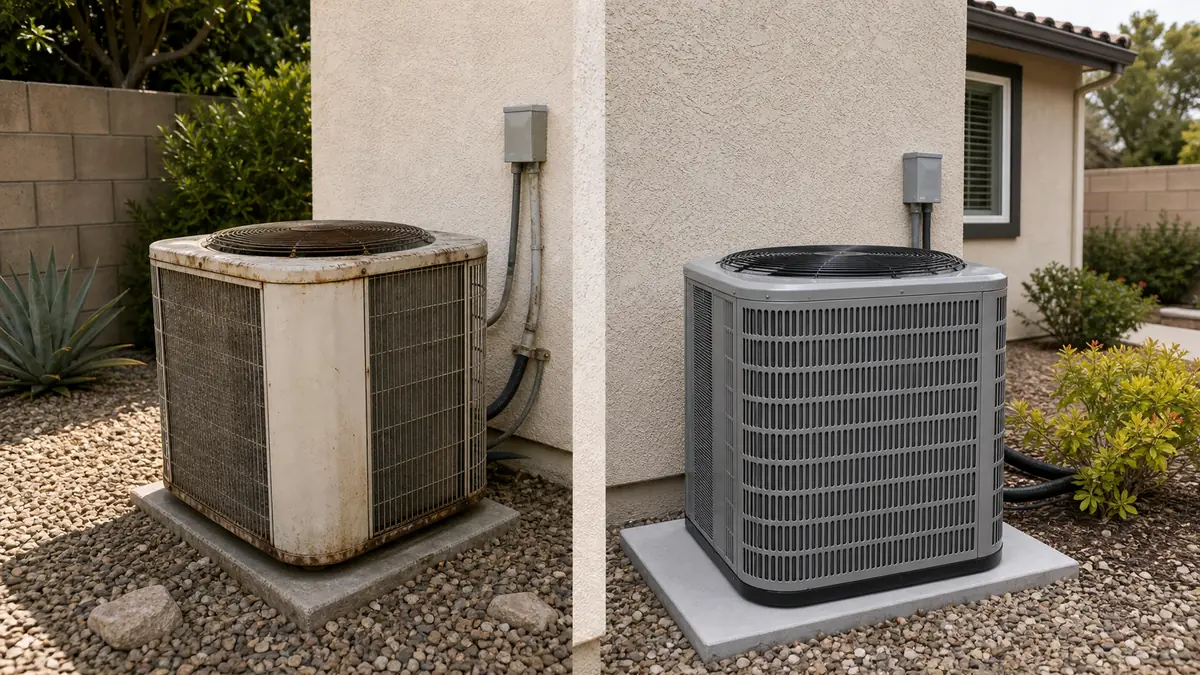
How do I decide repair vs. replace in Pomona?
Two heuristics carry most of the load. The 50% rule: if a single repair on a unit that has already logged 10 to 12 years would set you back about half of what a comparable new system costs, replacement usually wins out. The age-times-cost rule is your gut-check - take the unit's age in years times the repair quote, and if that product clears about $5,000, slide toward replacing. A 6-year XR16 wanting a $300 capacitor scores 1,800, an easy repair; a 16-year condenser wanting an $1,800 coil scores 28,800, an easy replace. Neither one is the final word - condition, service history, and refrigerant type all bend it - but stacked together they keep you honest.
What does a repair actually cost on a Trane?
Most Pomona repairs are small. The single most common SoCal failure, a dual-run capacitor, is cheap. The expensive repairs - a compressor or a communicating board - are the ones that tip the scales toward replacement on an old unit. Here is the real spread.
| Repair | Cost lane | Decision weight |
|---|---|---|
| Dual-run capacitor | $150 - $450 | Almost always repair |
| Contactor | $150 - $450 | Almost always repair |
| Condenser fan motor | $300 - $900 | Repair unless very old unit |
| Refrigerant leak + recharge | $225 - $1,500 | Depends on age and leak location |
| Communicating / inverter board | $400 - $2,000 | Weigh against replacement |
| Compressor (Climatuff) | $1,200 - $3,500 | Often replace if out of warranty |
What does replacement cost in Pomona?
A new central AC - condenser plus a matched coil - runs a typical 2026 SoCal $5,000 to $12,000 installed, the value XR sitting at the low end and the variable-speed XV20i at the top. Swing it to a full heat-pump system for an electrification swap and you are at $6,000 to $16,000. Baked into those figures are the City of Pomona mechanical permit and the refrigerant-charge and airflow HERS verification that Title-24 demands on a new split system in Climate Zone 9. Ducts that need sealing or rebuilding tack on another $1,900 to $6,000.
| New system | Best for | Installed lane |
|---|---|---|
| Trane XR single-stage AC + coil | Most Pomona homes; value | $5,000 - $9,000 |
| Trane XL two-stage / XV variable-speed AC | Comfort, quiet, top rebate tiers | $8,000 - $12,000 |
| Trane heat pump (ducted) | Gas-to-electric swap; one system | $6,000 - $16,000 |
| Plus duct sealing / rebuild | Older Lincoln Park / Wilton Heights stock | +$1,900 - $6,000 |
Worked examples: four real Pomona decisions
The heuristics are easier to trust when you see them run. Here are four common Pomona scenarios with the age-times-cost product worked out (unit age in years times the repair quote) alongside the 50% check against a roughly $7,000 comparable new XR system.
| Unit and fault | Age x cost | Call |
|---|---|---|
| 6-yr XR16, failed $300 capacitor | 6 x 300 = 1,800 | Repair - cheap part, young unit, far under $5,000 |
| 9-yr XL two-stage, $700 condenser fan motor | 9 x 700 = 6,300 | Lean repair - over $5,000 but the part is not catastrophic and the unit is sound |
| 14-yr XR14, $1,800 R-410A coil leak repair | 14 x 1,800 = 25,200 | Replace - well past both rules; aging R-410A unit |
| 16-yr condenser, $2,800 Climatuff compressor out of warranty | 16 x 2,800 = 44,800 | Replace - the repair is ~40% of a new system on a unit at end of life |
The middle case is the instructive one. The age-times-cost product clears $5,000, which nudges toward replacement, but a 9-year unit with a sound compressor and a single mechanical part failing is usually worth the fan motor - the rules are a guide, not an autopilot, and a fan motor is nothing like a compressor or a leaking coil. The two clear-replace cases share a pattern: a high-dollar repair (coil or compressor) on a unit already past 12 to 14 years, often carrying R-410A. That combination is where sinking cash into old iron stops making sense.
What hidden factors tip the decision?
Beyond the two formulas, several real-world factors bend the call in Pomona. A unit with documented annual maintenance and a clean service history earns more repair benefit of the doubt than a neglected one baking against a fence. A failed part that signals deeper trouble - a compressor that grenaded and contaminated the refrigerant circuit, or a coil leak on an all-aluminum Spine Fin coil that is hard to spot-repair - argues for replacement even mid-life. Comfort complaints matter too: if you have always hated how the single-stage unit leaves the upstairs hot, a failure is the natural moment to step up to two-stage or variable-speed rather than rebuild what never satisfied. And timing counts in a cooling town - replacing a marginal 14-year unit in the calm of April beats limping it into July and getting stranded mid-heat-wave when every shop is slammed. We weigh all of it instead of reading you a number off a chart.
How does Pomona's heat change the math?
Pomona logs roughly 60 to 80 days a year at or above 90 F with regular 100 F-plus Santa Ana stretches - one of the hottest reads in the San Gabriel Valley. That sustained load shortens equipment life at the top end and makes reliability worth more than in a mild coastal town. A marginal 14-year unit that limps through a cool spring can strand you mid-heat-wave, so the "replace before it dies in July" calculus is stronger here. It also means a properly sized, well-maintained system pays back its efficiency faster on the cooling side.
What about the R-410A refrigerant phase-down?
R-410A, the refrigerant in most current and recent Trane systems, is being phased down industry-wide. Recharging a leaking older R-410A unit gets progressively more expensive as supply tightens. For a 12-plus-year system facing a major leak or coil repair, that future cost is a real thumb on the replacement side of the scale - new equipment uses current lower-GWP refrigerant. For a newer system with a minor leak, it is a non-issue. We factor your unit's refrigerant and age into the recommendation.
What do Pomona rebates and tax credits actually offer in 2026?
Straight talk here, because getting it wrong costs homeowners real money. The federal Section 25C tax credit - 30% of project cost, capped at $2,000 for heat pumps - was repealed effective December 31, 2025. Only gear bought and installed on or before that date goes on the 2025 return; for a 2026 install there is no federal 25C credit at all. Over on the state and utility side, LADWP has reported up to $2,500 per ton on qualifying heat pumps, SCE about $1,000 a system, SoCalGas up to $600 on 92%-plus AFUE furnaces, and TECH Clean California roughly $1,000 to $1,500 - but TECH single-family funds were reported fully reserved statewide early in 2026, and these programs cycle through funding phases that pause and reopen. Check the live amount and funding status on the official program page before any rebate steers the decision. We will help you run that check, and we never dangle an expired or tapped-out incentive.
What does the replacement process actually involve in Pomona?
If the math lands on replace, know what you are buying beyond the box. A proper Pomona changeout starts with a Manual J load calculation so the new Trane is sized to the home, not to the old unit's nameplate - the old one may well have been oversized. The crew recovers the old refrigerant to EPA standards, sets the new condenser and matched coil, and either reuses sound line sets or runs new ones, flushing or replacing as the refrigerant type demands. Then comes commissioning: pulling a deep vacuum to remove moisture, weighing in the exact factory charge, and verifying superheat and subcooling against the data plate. The City of Pomona requires a mechanical permit for the changeout, and Title-24 Climate Zone 9 triggers refrigerant-charge and airflow HERS field verification by a third-party rater on a new split system; if ducts are touched, duct-sealing HERS verification applies too. Those steps are baked into our install quote, not sprung after. A communicating XV system also needs its ComfortLink II control set up and the staging confirmed. Skipping the vacuum, guessing the charge, or dodging the permit is how a cheap install becomes an early failure - the commissioning is what makes a new system actually deliver its rated efficiency in Pomona heat.
What is the bottom line for my Pomona home?
Repair a sound unit under about 12 years with a cheap electrical or single-leak fault. Replace a unit past 12 to 15 years that needs a compressor, a communicating board, or a major R-410A leak repair - especially before peak summer. When it is genuinely a coin flip, the deciding factors are maintenance history and how the unit handled last July. Read the matching pages: AC not cooling diagnostics, the Trane buying guide, and XR-series options. Then call us for the actual numbers on your unit.
Common questions
What is the 50% rule for AC replacement?
When a single repair would cost you more than about 50 percent of what a comparable new system runs AND the unit has logged more than 10 to 12 years, swapping it out usually beats sinking cash into tired equipment. Newer iron, or a cheap fix, and the rule points the other way - repair. Treat it as a guide rather than gospel, because condition and refrigerant type swing the call too.
Does R-410A being phased down change my decision in Pomona?
It nudges older units toward replacement. R-410A is being phased down industry-wide, so recharging a leaking 12-plus-year R-410A system gets pricier and the refrigerant harder to source over time. If that unit needs a major leak repair, replacement with current refrigerant equipment is often the smarter long-term call.
Is it worth replacing just to get a rebate in Pomona?
Not until you have confirmed the rebate exists and is funded today. A handful of California heat-pump programs were reported fully reserved or paused going into early 2026, and the federal 25C tax credit ended December 31, 2025. Do not hang a replacement decision on an incentive you have not checked is live right now.
How long should a Trane AC last in Pomona's heat?
Roughly 12 to 18 years, but Pomona's sustained 90 F-plus load shortens the upper end versus a mild coastal climate. A well-maintained Trane with annual coil cleaning and capacitor checks reaches the longer end; a neglected unit baking against a fence fails sooner.
Last updated 2026-06-13.