Trane Error Codes in Pomona
No-fluff answer: A Trane error code in Pomona, CA (ZIPs 91766, 91767, 91768) is the integrated furnace control flashing a fault on its status LED, and the flash count tells you whether it is airflow, ignition, draft, or wiring. Call Pomona Trane HVAC at (213) 449-4344 or book online and we read it on-site.
Key details
- Read the code through the lower-panel sight window: count LED flashes between pauses.
- Common Trane furnace flash codes: 2 lockout, 3 pressure switch, 4 high-limit, 6 polarity/ground, 7 gas valve, 8 flame sense.
- Furnace IFC codes only - a non-communicating Trane condenser gives no numeric code.
- American Standard furnaces share the same board and the same chart.
- Repair lane: most flash-code fixes land in the $119 to $700 range for 2026 SoCal.
- Service area: Pomona + Lincoln Park, Wilton Heights, Hacienda, Phillips Ranch, Westmont (91766-91768).
What do Trane error codes mean on a furnace?
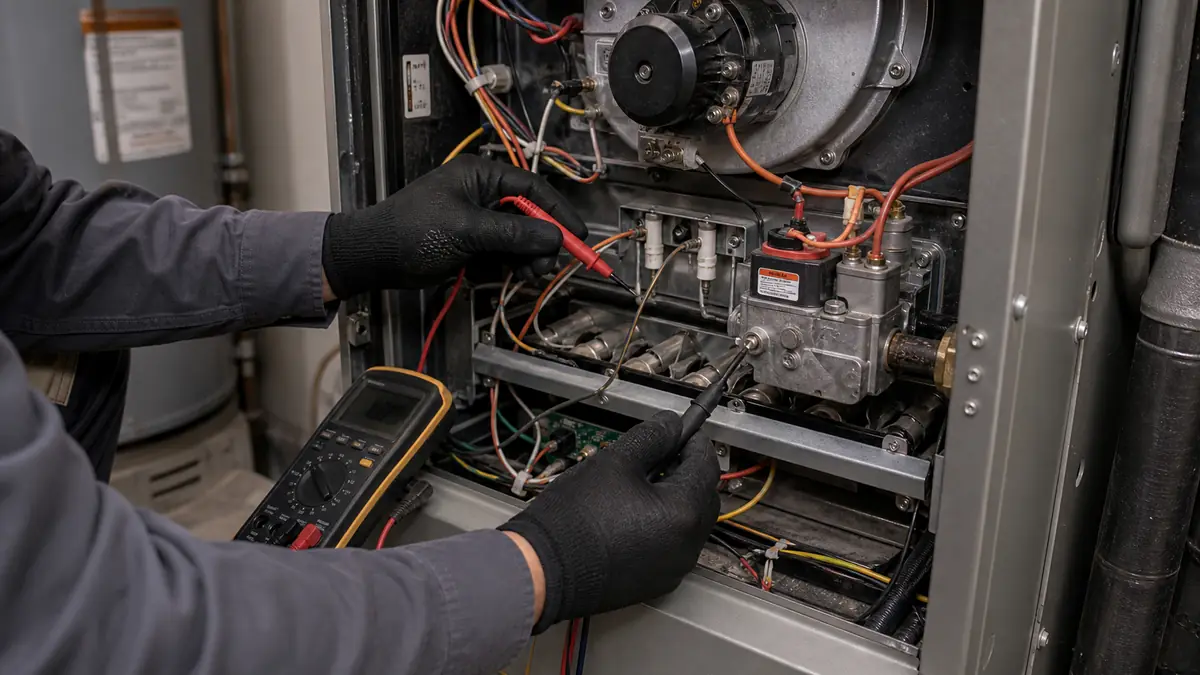
On a Trane gas furnace the brains is the integrated furnace control - the IFC, the green board bolted inside the burner compartment. It watches the inducer, the pressure switch, the igniter, the flame sensor, the high-limit, and the gas valve, and when one of them reads wrong it shuts the sequence down and blinks a number on its status LED. That blink count is the error code. It is not a guess; it is the board telling you which tool to reach for on the bench. In Pomona's far-eastern San Gabriel Valley heat the furnaces sit dark from April to November, so the first cold morning is when these codes light up - dust on a flame sensor, a varnished igniter, an inducer bearing that stiffened over the summer. The chart below maps the common Trane codes to the part and the 2026 SoCal cost lane.
| LED flash code | Meaning / first check | Cost lane |
|---|---|---|
| 2 flashes - system lockout | Ignition retries exceeded; full ignition diagnosis | $150 - $450 |
| 3 flashes - pressure switch | Inducer not proving draft; blocked flue or weak inducer | $150 - $700 |
| 4 flashes - open high-limit | Overheat from low airflow; clear the restriction | $119 - $600 |
| 6 flashes - reversed polarity / poor ground | Line wiring or ground fault; correct and verify | $119 - $200 |
| 7 flashes - gas valve circuit | Valve or valve wiring fault; test valve | $150 - $700 |
| 8 flashes - low flame sense | Dirty or weak flame sensor; clean or replace | $119 - $350 |
The two codes Pomona homeowners ask us about most are 4 flashes - an open high-temperature limit and 6 flashes - reversed polarity or poor grounding. Each has its own page with the full diagnostic walkthrough, instrument readings, and cost. Start with the flash count, then open the matching page.
How do we read codes on a Trane in Pomona?
Same bench routine on every call. We kill power, pull the lower access panel, and confirm which board generation is in front of us - an older single-stage XR with a simple flashing LED, a two-stage XV80, or a communicating XC95m that puts a fault on the ComfortLink II screen. With power restored we watch one full cycle through the sight window and count the LED, because a code stored from last week can read differently than what the furnace is doing right now. A clamp meter goes on the inducer to check amp draw, a manometer taps the pressure-switch port and the gas manifold, and a microamp meter clips the flame-sensor lead - a healthy Trane sensor reads about 2 to 6 microamps, and anything down near 0.5 is the 8-flash code waiting to happen. The Pomona wrinkle is the housing mix: a 1920s Craftsman in the Lincoln Park Historic District often has the furnace crammed into a tight hall closet or a low attic, where return air is starved and the 4-flash high-limit trips far more often than it would in a roomy Phillips Ranch tract house with a proper mechanical closet. We read the code, but we also read the install around it.
How do we fix Trane furnace codes here?
We fix the cause the code points at, not the code itself. An 8-flash low-flame-sense is usually a clean - we pull the sensor rod, scuff the oxidation off with a non-abrasive pad, verify the microamps climb back into range, and confirm a stable burner. A 3-flash pressure-switch fault means proving draft: we check inducer amps, clear the flue and the condensate path, and replace the switch or the inducer only if the readings say so. A 4-flash high-limit is an airflow repair first - filter, blower wheel, coil, ductwork - because swapping the limit switch on a furnace that is genuinely overheating just hides a real problem and can crack a heat exchanger. A 6-flash is a wiring and ground correction at the furnace whip or the receptacle. We carry common Trane igniters, flame sensors, pressure switches, and limits on the truck, so most flash-code repairs are same-visit across the 91766 to 91768 ZIPs. Heavier parts - an ECM blower module, an inducer assembly, an IFC board - we source and schedule. If you want the underlying service, see Trane furnace repair in Pomona.
Why do these codes show up in Pomona homes?
Climate and housing stock, mostly. Pomona sits in Climate Zone 9 at the inland edge of the basin where the valley hands off to the Inland Empire, so summers run hot and dry and heating season is short. A furnace that runs maybe sixty to ninety days a year collects dust on the flame sensor and lets the inducer bearing dry out, then throws an ignition or draft code on the first cold snap. The older revival-era homes in the historic core - Craftsman, Mission, Tudor - were not built around forced-air, so furnaces got retrofitted into closets and attics with marginal return-air sizing, which is why the 4-flash high-limit and the 6-flash polarity code (often from an old two-prong-era circuit that got adapted) turn up here more than in the newer hillside tract on the Westmont and Phillips Ranch side. Dusty Santa Ana wind events load filters fast, too, which starves airflow and pushes a furnace toward that overheat limit.
When is a Trane code an emergency?
Most flash codes are urgent-but-safe: the furnace shut itself down on purpose, so you have no heat but no immediate danger. Two situations change that. First, any gas smell - rotten-egg odor - is a stop-everything emergency: leave the house, call the gas utility and the fire department from outside, and do not flip a single switch. Second, a repeating high-limit lockout (4 flashes) that keeps coming back can point at a heat-exchanger problem, and on any Trane furnace a confirmed cracked heat exchanger gets red-tagged, never patched. A 6-flash polarity or grounding fault is also worth treating seriously, because poor grounding can disable safety circuits. When in doubt, leave it off and call - we cover Pomona and the surrounding neighborhoods for same-week and emergency HVAC service.
Common questions
Where do I find the flash code on a Trane furnace?
On the lower burner-access panel there is a small sight window; behind it the integrated furnace control (IFC) blinks a red or green LED. Count the flashes between the long pauses - that number is the code. On a few communicating XC and S-series boards the code shows as a two-digit number on a small display instead of a flash count.
Does my Trane AC or heat pump throw the same codes?
No. The flash codes here are furnace and air-handler IFC codes. A straight-cool Trane condenser (XR13, XR14, XR16) has no numeric code - it is diagnosed by metering the capacitor, contactor, and refrigerant pressures. A communicating XV or XL system reports faults through the ComfortLink II thermostat as text, not a flash count.
Can I clear a Trane error code myself?
Cutting power at the furnace switch for thirty seconds resets the board and clears a soft lockout, and that is a reasonable single attempt. But if the same code returns, the underlying fault is still there - a dirty sensor, a weak inducer, a tripped limit - and resetting on a loop just delays a real repair and can be unsafe on gas-side faults.
Are Trane and American Standard furnace codes the same?
Yes, functionally. American Standard furnaces share Trane's chassis and the same integrated furnace control, so the flash-code chart is identical. If you own an American Standard Freedom or Platinum furnace in Pomona, the 2-flash, 3-flash, 4-flash and 6-flash codes mean exactly what they mean on the Trane equivalent.
Last updated 2026-06-13.